





Expert Insights: Small Business Trending toward Growth in 2026
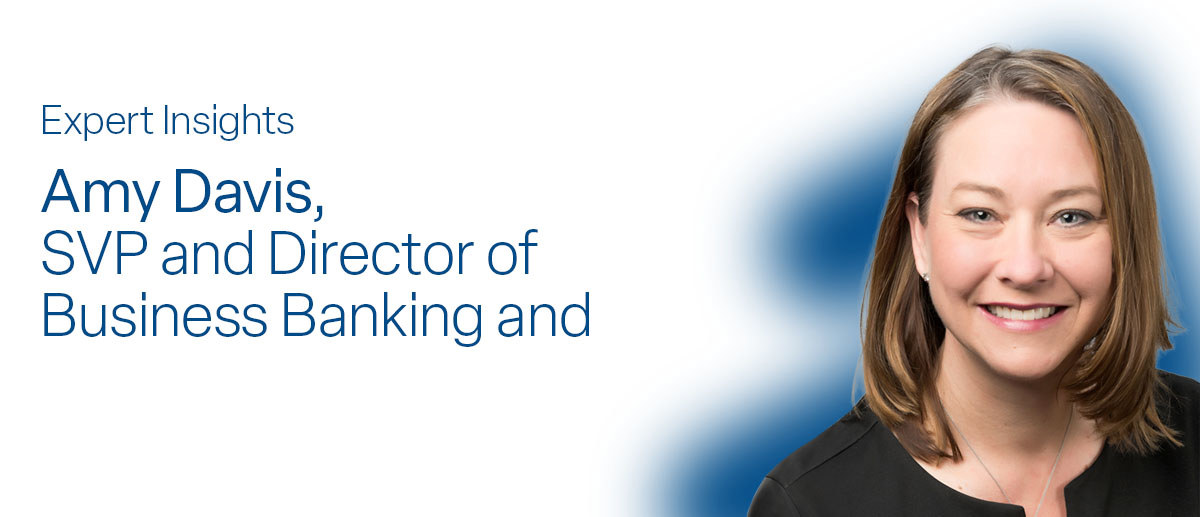
Amy Davis, SVP and Director of Business Banking and SBA Production
Small businesses have shown incredible resilience in a year marked by uncertainty and change. The U.S. Small Business Administration issued a record total of $37 billion in 7(a) loans during their fiscal year 2025. Meanwhile, the latest sentiment findings from the National Federation of Small Businesses shows that small business optimism edged up in November on the strength of expectations for higher sales volumes.
In this Q&A, Amy Davis, SVP and Director of Business Banking and SBA Production, shares her perspective on what is driving small business optimism and record SBA lending, and what to expect in the year ahead.
Q: How would you describe current sentiment among small businesses?
We saw small business outlook reach a four-year high when we fielded our annual Business Barometer at the mid-point of the year, and that positive sentiment appears to remain intact as we enter 2026. There was concern and uncertainty among small business owners in the first half of 2025, but the tide has turned as businesses forge ahead with renewed confidence. We see more small business customers investing in expansion or considering expansion as they become more comfortable with making decisions based on the current macroeconomic environment.
Q: What surprised you most about the small business environment in 2025?
The fact that the SBA reported record loan issuance, despite returning to their original policies and procedures focused on prudent lending standards, was a little surprising and a very positive sign in terms of small business owner confidence. In June of 2025, the SBA reinstituted previous underwriting requirements and reduced the SBA Express loan limit back to $350,000 from $500,000. Simultaneously, the SBA saw an increase in the number of approved 7(a) loans from 70,000 to nearly 78,000. This record volume of 7(a) loans reflects more small businesses pursuing loans to grow and expand, marking renewed optimism on a national scale.
Q: What does this record volume of SBA lending say about the state of small business?
It's a sign that more small businesses are deciding to forge ahead, securing funding for expansions, acquisitions and ground up construction. This growth-focused, positive momentum is a reversal of a trend over the past few years when many small businesses focused on 504 loans, which are less versatile than 7(a) loans and not for acquisitions or working capital needs.
While many small business owners were previously willing to take on debt to purchase the commercial property they were renting, they were not necessarily looking to expand their footprint or buy new equipment. We’re encouraged by what we’re seeing and hearing within our customer base, and we expect this growth to continue in 2026. Further, with interest rates dropping, coupled with inflation decreasing, businesses will be set up for tremendous opportunities throughout 2026.
Q. How have SBA lending standards evolved over the past year, and what does it mean for businesses?
Coming out of the pandemic, standards were adjusted in an effort to facilitate and support businesses. We saw great variation in standard SBA lending practices across all institutions and non-bank lenders over the past few years because of the previous “Do what you do” policy. It was not uncommon to see loans approved using each individual bank’s underwriting standards instead of SBA underwriting and closing standards, without banking relationships, or the involvement of a relationship manager to help them continue their business growth journey. Such loans had a higher propensity for default. In June 2025, the SBA moved back to what they have done in the past, including the charging of guarantee fees that were previously suspended.
Columbia Bank has long maintained a set of conservative standards within our SBA business because we want to know what each business is, how it’s looking to grow in the future, and how we can help and protect it over the life of the business. This has resulted in a higher concentration of loans going funded for businesses with significant growth potential in 2026 and beyond.
Q. In summary, what is your advice to small businesses as we enter 2026?
I always tell customers that you can't just keep doing and continuing to do the same things you have always done in the past. The key is finding the balance to remain forward-looking without being so committed that you’re unable or unwilling to pivot if you start to see changes that will impact your business. It’s important to discuss your plans and the diverse options that may be available with your banking partner, even if it’s just for an educational opportunity to plant the seeds for a business owner to dream big. When that happens, the relationship can blossom into a lifelong relationship for everyone involved.
This is why having a strong banking partner that looks out for your business’ long-term interest is also critical. Businesses should look for a banking partner that is invested in the long-term success of the business and not just a one-time transaction.
